The “systems approach” we use to develop competency-based standards is based on work on competency models adopted by the US Department of Labor, Employment and Training Administration. They have built a competency model framework that captures foundational competencies, industry-related competencies, and occupational competencies in a pyramidal hierarchy as shown in Figure 1.
This USDL model includes 9 separate tiers, each containing related competencies. The tiers are hierarchical, and the closer to the base of the pyramid you go (ie, the lower tiers) the more universally applicable these competencies become. Conversely, the further up the pyramid you move, the more specific and specialized to a particular occupation the competencies become.
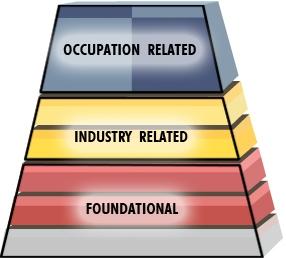
This model is useful because it begins to show the inter-relationship between occupations on a competency basis, which is fundamental to our ‘systems view’ of competencies, occupations, career paths, labour markets and national economies.
So where do occupational standards fall into the mix? Figure 2 shows a more detailed view of the 9-tier pyramid, and in this view, occupational standards would be encompass the competencies in Tiers 6 through 9. They would incorporate elements of core industrial competencies (Tiers 4 and 5) and would be build on Foundational competencies (generally referred to in Canada as “Essential Skills”) in Tiers 1 through 3.

Key Requirements for Occupational Standards
Performance: Since occupational standards support both the development of competency and the recognition of competency, they must contain information that allows the measurement of performance. These measures could be qualitative or quantitative; regardless, they must take into account the variability inherent in the workplace (for example, it may not be possible to perform a job at the same productivity level in the winter months as in the summer months, due to environmental factors).
Performance is linked to mastery of competencies. The degree of mastery can follow a scale from “no ability” through “expert”. The performance standard for a competency will articulate where on this sliding scale we expect someone to be for a particular occupation.
Common Language/Conventions: Occupational standards built from modules of competency allow one occupation to be compared to another – provided they use a common vocabulary and common format to describe competencies. This is a key component of this project: to come up with that common framework.
Current and Relevant: Finally, occupational standards have to be developed through a rigorous and repeatable process, and this process should contain a built-in feedback mechanism that allows the standards to be continuously updated and improved. Ideally, the feedback mechanism allows the largest number of practitioners, managers, regulators and other stakeholders provide their input, and the standards are updated in a timely manner. Current technologies (wikis and other “open source” paradigms) may allow standards to be updated on a far more frequent basis than in the past.

Figure 3 illustrates our model of inter-connected occupational competency models. While only two occupations are shown, many more could be added.
Summary
The key components of our Systems Model of Occupational Competency are:
- Occupational standards underpin a system of competency for an occupation
- The system of competency includes both competency development and competency recognition
- An occupational standard is made up of units or modules of competency
- Modules of competency may be common to more than one occupation, or unique to a particular occupation
- Degrees of proficiency can be defined for every module of competency. These are related to the mastery of the competency
- Mastery in a competency is characterized by the degree of independence or autonomy of the individual (ie, can they perform the competency on their own, without supervision or assistance), the likelihood of committing an error, the variety of situations and environments where the competency can be performed, and the speed and accuracy of performance
- A feedback mechanism is organic to the system, which allows the modules of competency to be continuously improved. Changes in one part of the system may generate sympathetic changes to other parts of the system until a new equilibrium or steady-state is achieved.
- Every occupation is related to every other occupation and the overall economy via competencies and levels of proficiency. This enforces a common language and common measures on the standards so they can be easily compared to each other.
- Similar occupations can be clearly linked via career paths/ladders