<another piece from way back that I’ve kept… >
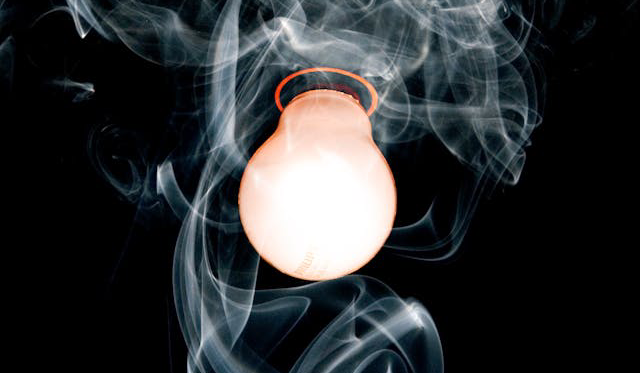
Positive ground depends upon proper circuit functioning, the transmission of negative ions by retention of the visible spectral manifestation known as “smoke”. Smoke is the thing that makes electrical circuits work; we know this to be true because every time one lets the smoke out of the electrical system, it stops working. This can be verified repeatedly through empirical testing.
When, for example, the smoke escapes from an electrical component (i.e., say, a Lucas voltage regulator), it will be observed that the component stops working. The function of the wire harness is to carry the smoke from one device to another; when the wire harness “springs a leak”, and lets all the smoke out of the system, nothing works afterwards.
Starter motors were frowned upon in British Automobiles for some time, largely because they consume large quantities of smoke, requiring very large wires.
It has been noted that Lucas components are possibly more prone to electrical leakage than Bosch or generic Japanese electrics. Experts point out that this is because Lucas is British and all things British leak. British engines leak oil, shock absorbers, hydraulic forks and disk brakes leak fluid, British tires leak air and the British defense establishment leaks secrets…so, naturally, British electronics leak smoke.
Further Discussion of “The Theory”
When wires smoke, how come the smoke is not the same color as the wire?
This is not completely true. When the smoke is in the wire, it is under pressure (called voltage). The pressure difference causes the color to change from the normal color we are used to. Not unlike the blood in our veins and arteries changing color due to the oxygen content. When the smoke escapes the wire and is exposed to air, the pressure is released, and the color reverts back to what we commonly recognize as smoke. The wire then changes to the color of the smoke that escaped. I hope this helps you understand.
I would only question the last sentence of that description. It has been my experience that the wire turns a color directly opposite of the smoke.
Not always true, I think it must depend on the composition of the smoke in question.
I should have made it a little clearer; the color the wire becomes, is directly proportional to the escape velocity of the smoke. Higher velocities generate higher heat. This heat tends to burn the wire and affect the coloring. The statement was meant to be a generalization, indicating the fact that the color of the wire does in fact change. Sorry for the miscommunication. I was speaking of electrical smoke which is generally white. The spent smoke casing generally assumes a color somewhat near black after the smoke leaves.
I can’t stand it anymore! If, as you say, light bulbs suck up darkness and convert it to smoke which is transmitted (via wire) to a power source for recycling…why do car batteries go dead when lights are left on? Do car batteries (and flashlight batteries for that matter) have a limited amount of storage capability? Is it like a hard drive that gets so full that you have to double-space and then lose all data? Now you’re getting it……. I thought you guys were smarter than this. Of course the battery stores the smoke. In fact it can store so much smoke that if you open the top and light a match, the resulting explosion can do serious damage. I’m sure you are aware that usually where there’s smoke there’s fire. If you connect the battery to a charger, the smoke is then returned to the wire (Remember, a light bulb wont work unless it is connected to a wire system) for the utility companies to use. Your hard drive analogy is a very good example. Our hardware guys might be onto something in their quest for superior wiring. I have noticed the unique method of of series/parallel wiring the power strips on our systems seems to prevent the smoke from getting out of the wires. A “Smoke Loop” of sorts. In the case of the “smoked” workstation recently, you should notice that this was a conventional single power strip installation. Since color is percieved by the cone shaped receptors in our eyes, and cones require more light that their rod shaped counterparts. Is the sky blue at night? At night the process including contraction of the pupil is visual purple by which the eye adapts to conditions of increased illumination when facing 300 candle power redeflecting devices. Since there is a spectrum of light that we as humans cannot see, I support the theory that everything is going up in smoke, we just can’t see it. This may explain why the neighbors dog barks for no apparant reason. I think your basic understanding of smoke systems is remarkable. However I find a flaw with your theory. The battery is a reusable storage device for smoke. therefore, one would assume that some sort of one way valve (we can call it a diode) should be needed to prevent pressure flooding back into the system while at rest. Unlike the A/C system, the smoke system is collecting darkness at the headlights and converting it to smoke. This causes the system to fill up. The battery can contain much higher pressures and volumes than the wires. If this pressure exceeds the capacity of the wire, it will cause a rupture as you described. The rupture can be controlled by a sacraficial device known as a fuse. But this still doesn’t eliminate the problem. Perhaps a two way valve (zener diode) is used to allow a small amount of pressure to return to the system, and partially equalize. I find this theory unlikely though, due to the increase in the force required to start the pump (which is now under pressure) working again… The smoke continues circulating through the system, due to the pressure differential in the battery (smoke pressure/vacuum reservoir). When the reservoir becomes depleted, the pressure simply equalizes everywhere in the system (similar to an A/C system when it’s turned off) and stuff just wont work. Notice the relations: Work (W) = Force (F) x Distance (D); Force (F) = total difference in pressure (Dp) x Area (A). Therefore, the work done in a pressure system is: Dp x A x D. If the pressure differential (Dp) is reduced to zero then W = 0 x A x D = 0. The smoke only escapes the wires when a path is created between the pressure differential areas (@ either the reservoir or the pump) that has too little restriction. When this happens, the smoke travels through the wires so fast that the friction between the smoke and the outer walls of the wiring heats the wires until they rupture. The smoke continues to escape until its pressure is equalized with the atmosphere, or until the conduit that provides the path between pressure areas is severed. When this happens, the sudden drop in pressure allows the wires to “collapse” slightly and, being soo hot, as the edges of the ruptures and severed ends touch, the material becomes fused, sealing the system and retaining the remaining smoke. Don’t forget, when the system is at rest, all the valves, (switches and relays) are closed, keeping the pressure areas separated. When restarting the pump, as long as everything is OK, the smoke pressure is equal on both sides of the pump and there is no net force on the pump when it begins operating again. Also, within the pump there are pressure/volume actuated one-way valves with restrictors built in, arranged in such a way that they keep excess smoke volume recirculating through an integral smoke loop, which maintains the pressure within manageable limits. The excess smoke, created by the light/smoke converters (headlights and other darkness absorbing devices), is changed back to darkness and dissipated in small unit concentrations so its dark effect is not locally observed. The smoke pump impeller (stator), converts smoke into magnetic flux which does work on the engine. Some of the excess work energy is dissipated through the cooling system and exhaust in the form of heat, while the remaining work energy is converted back to smoke and distributed evenly in small concentrations as you drive. This maintains the total quantity of smoke in the system at an average that does not change over time.
Bloody trailer electrics
Cursed damned things
Left hand indicator on the boat trailer wasn’t working. I noticed this when I tried to use it last but couldn’t get the lens cover off thanks to a frozen screw so left it and went boating anyway (fortunately the car lights are visible past the wee boat). Today I settled down to have a real go at fixing it … and lo and behold, a minute squirt of RP7 had the screw sliding out happily – it had to be a minute squirt because the can decided that was the time to go empty Funny thing is, I swear it went in the wrong place.
Anyways, the screw came out … but do you reckon the lens cover would come off? Of course not, the plastic gasket had welded everything together. Serves me right for buying cheap lights doesn’t it.
So now I’ve got access to the bulbs … and, of course, the offending bulb looks perfect.
Okay, I get into the car, turn it around in the driveway so the bum is facing the trailer, pick up the trailer and drag it to the back of the car, hook up the trailer and test the lights.
Nope, that indicator still isn’t working … and neither is the other side
So off comes that lens and sure enough, that bulb looks perfect too.
Wriggle everything in sight.
Resettle the trailer lights plug a few times.
Pull and tug at anything pullable and tuggable.
Give the wheel a kick.
No indicators.
So I wander inside and dig out the trusty multi-meter, which is a real hoot because when it comes to electrics, I subscribe to the smoke theory – how I ever came to own a multi-meter is a mystery, let alone two of the things.
Back at the trailer, I make a guess at where to set the dial, try the meter, try a few more settings, finally get one that provides numbers, and apply those wee probes to the right hand indicator … which immediately starts flashing
I glared at the thing, dared it to stop working, and then went back to the left hand indicator, the original cause of all the drama.
No indicator.
No numbers on the multi-meter.
So I started trying things. Yes, there was power at the trailer plug. I tested every combination of bits and pieces in the light itself. Everything I tested said that light should be working … only it wasn’t … until I tried the final, improbable test and that damned light started flashing.
So I now I have two working indicators (and brake lights and tail lights). They were even working after I screwed the lens covers back on
No sign of any problem though, nothing found that could have explained the mystery. Sure, I’d been moving and twisting things in the hope of clearing whatever bit of corrosion might have been stopping the smoke from flowing through the wires but with both lights, they started working only after I’d applied the multi-meter to the ‘right’ place.
So, in addition to the smoke theory of electricy, I can now add the fear theory. The demons that provide the smoke for the electricity are actually scared of multi-meters and if you threaten them with said meter, they start to provide the smoke. It only took me so long because I didn’t know what I was doing and the demons weren’t intimidated enough to act at first.
I hope to use the boat tomorrow. No, I will not be testing the lights before heading off, I can do without the drama.
The missile knows where it is at all times. It knows this because it knows where it isn’t. By subtracting where it is from where it isn’t, or where it isn’t from where it is (whichever is greater), it obtains a difference, or deviation. The guidance subsystem uses deviations to generate corrective commands to drive the missile from a position where it is to a position where it isn’t, and arriving at a position where it wasn’t, it now is. Consequently, the position where it is, is now the position that it wasn’t, and it follows that the position that it was, is now the position that it isn’t.
In the event that the position that it is in is not the position that it wasn’t, the system has acquired a variation, the variation being the difference between where the missile is, and where it wasn’t. If variation is considered to be a significant factor, it too may be corrected by the GEA. However, the missile must also know where it was.
The missile guidance computer scenario works as follows. Because a variation has modified some of the information the missile has obtained, it is not sure just where it is. However, it is sure where it isn’t, within reason, and it knows where it was. It now subtracts where it should be from where it wasn’t, or vice-versa, and by differentiating this from the algebraic sum of where it shouldn’t be, and where it was, it is able to obtain the deviation and its variation, which is called error.
GLCM GUIDANCE SYSTEM
Submitted by Colonel (Ret) George Grill, who was with General Dynamics at Greenham Common AB, England – it may not be the first time you have seen this – is seems to apply to all guidance systems.
The missile knows were it is at all times. It know this because it knows where it isn’t. By subtracting where it is from it isn’t, or where it isn’t from where it is (whichever is greater), it attains a difference or deviation. The guidance system uses deviations to generate corrective commands to drive the missiIe from a position where it is to a position where it isn’t, arriving at a position where it wasn’t, but is now. Consequently, the position where it is, is the position where it wasn’t. So it follows that the position where it was, is the position where it isn’t.
In the event that the position where it is now is not the position where it wasn’t, the system has acquired a variation – the variation being the difference between where the missile is and where the missile wasn’t. If the variation is considered to be a significant factor, the missile guidance logic system will allow for the variation, provided that the missile knows where it was or is not now.
Due to the variation modifying some of the information obtained by the missile, it is not sure where it is. However, the thought process of the missile is that it is sure where it isn’t, and it knows where it was, It now subtracts where it should be from where it wasn’t and adds the variable obtained by subtracting where it isn’t from where it was. In guidance system “language” this is called error, or the difference between deviation and variation found in the algebraic difference between where the missile shouldn’t be and where it is. Simple.